

Nota · For everything you are responsible for
One glance, and you know nothing is on fire.
- What needs my attention?
- What does it mean in money?
A server, a nightly backup, an AI process, a domain, an invoice, a tax deadline, a project. Nota answers the two questions for all of them and hands you, or your coding agent, a Brief: the context needed to act. Nota itself never acts.
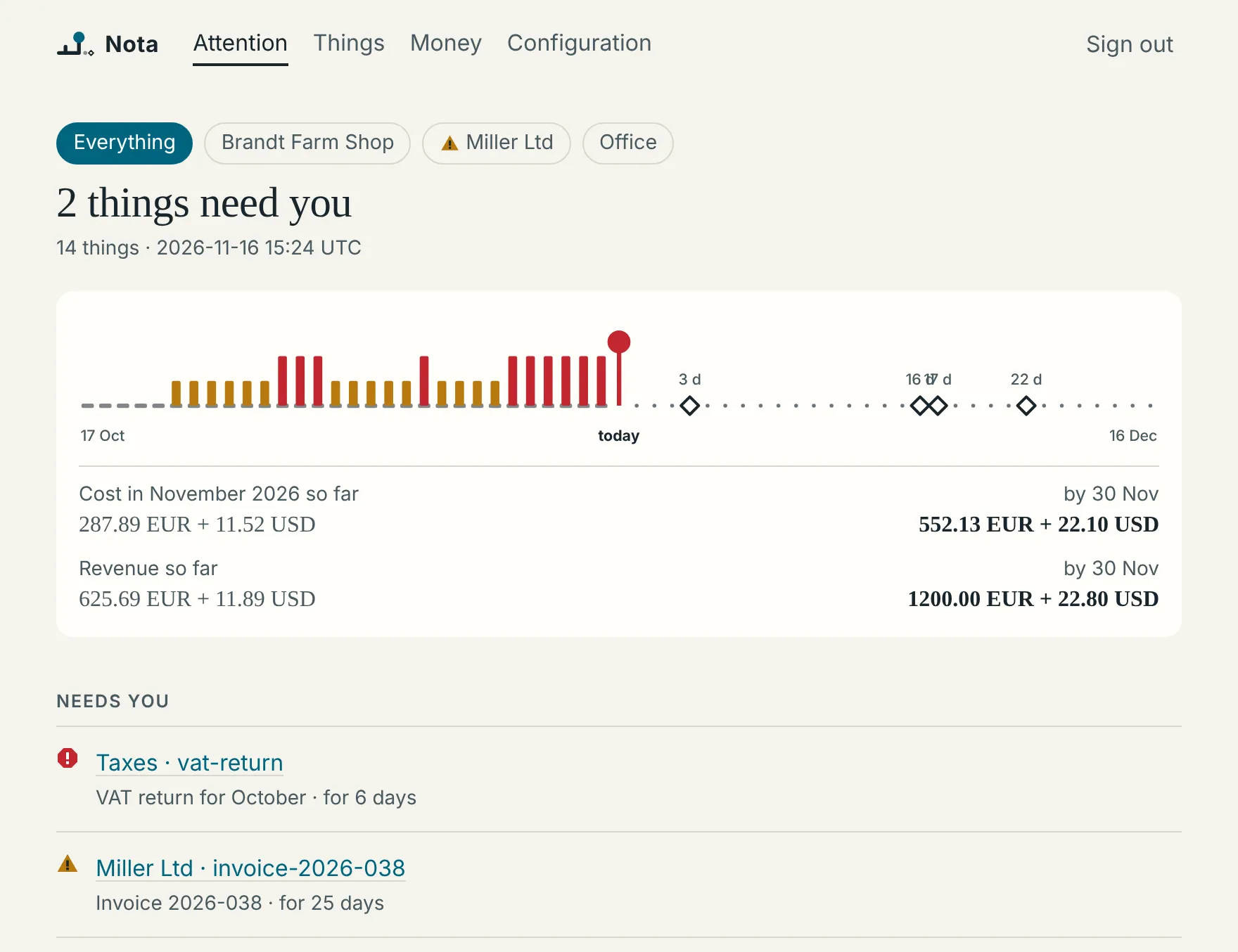
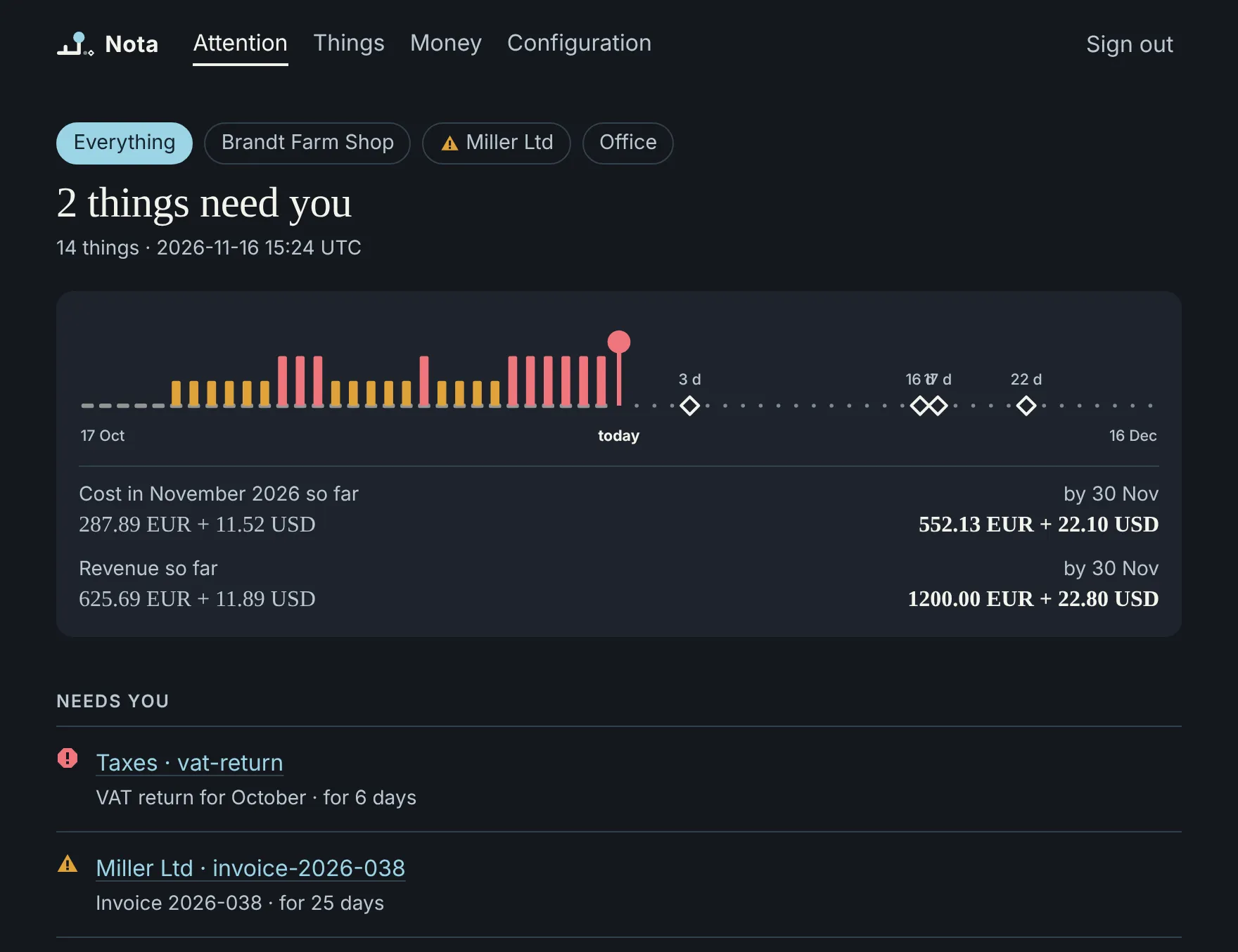
The hand-over is a Brief
For everything that needs you there is a Brief, without setting anything up. It says what is wrong and since when, and brings along what Nota knows: whether it happened before and for how long, what follows from it, the last events, and what helped the last time.
Copy it for a person or a coding agent. An agent can ask back through a read-only MCP endpoint. Whoever fixed it says in one sentence what helped, and the next Brief carries that sentence.


What a source is
A source is a program or a file you already have. It reports its part, and no source needs to know of another.
Nota evaluates what arrives with three rules: a reported state, a threshold, and something that fails to arrive.
Things are ticked off where they live: in the ledger, the task list, the spreadsheet.
- A list kept as CSV
- A plan from a template
- todo.txt
- Taskwarrior
- Beancount
- Checks from outside: HTTP, TCP, TLS
- The machine it runs on
- Hetzner Cloud
- An agent with Vector
- Grafana and Alertmanager alerts
- Any program, over HTTP
What it is good for
Five situations, each played through a real core as a test. The numbers come from those tests. Infrastructure is one example among several.
A freelancer’s office
1,164.51 EURClient Brandt brings 1,200.00 EUR, costs 35.49, and that is the balance. The VAT return is six days late, and Miller owes 2,400.00 USD since 22 October. The sources: a ledger, a todo.txt and a spreadsheet.
A homelab
2 probes, 1 warningOne probe sees a failure, the other does not: a warning, not an alarm. When the host dies it is the cause; the service on it is shown as a consequence and pages nobody.
An AI process
−2.00 USDIt cost 22.10 USD, 24.80 with its nightly evaluation. 57 solved tickets at 0.40 brought 22.80 USD, so the client’s process runs at −2.00. When the evaluation silently stops, it is noticed after a day and an hour.
A small agency
+254.51 EUR · +587.60 USDMoney per client, Brandt and Miller side by side, two currencies never added. A client’s line covers everything that belongs to the client, though the monitoring never speaks about clients.
A project from a template
4 days late, 4 days laterThe concept is done four days late, and every step after it moves by four days. An invoice is planned until its milestone is done and owed from that day.
What Nota deliberately is not
- Not accountingNo accounts, no tax, no receipts. The ledger stays the book; Nota reads from it.
- Not a to-do appOnly tasks with a due date appear. The task list stays where it is.
- Not project managementNo chart, no resources, no percent complete. A schedule that says what is due.
- Not a dashboard builderNo query language, no charts of your own. One fixed view that looks the same for everything.
- Never actsIt starts, stops and changes nothing. It hands over: to you or to an agent.
Start in two minutes
Nota is one Go program and one SQLite file, and you run it yourself. You need a machine with Go; the commands run in the core/ folder of Nota’s source.
go build -o nota ./cmd/nota./nota init my-notacd my-nota && ../nota serveOpen http://127.0.0.1:8080 and sign in with the token that nota init showed once. You see something at once: the example rows of two lists, and this machine with disk, memory and load.
The state of things
This site describes what works today and says where something is still missing.
- Works todayThe core, the probe, the agent and the dashboard in English and German. Lists, plans, todo.txt, Taskwarrior and Beancount as sources. The Brief, the read-only MCP endpoint, notifications through ntfy and webhooks.
- In developmentThe iPhone app with its home-screen widget. It is built and tested automatically, but has not been seen on a device and is not in the App Store. There is no date.
- Not yetPush to the phone. It needs a relay that is not running yet.
- Not decidedPrices and the licence. The server parts are meant to be open source and free to run yourself, the apps paid by subscription. What is decided and what is not.